
Swirl Removal
Swirls
Swirl removal is a very important step in proper surface preparation. A swirled (commonly referred to as spider webbed) surface will make even the best waxes appear unacceptable, and often leave the user wondering if he chose the wrong type of polish/wax. Swirls are countless clusters of micro scratches usually caused by improper washing and/or drying. They are much easier seen on darker colour cars, and when the vehicle is in direct sunlight.
Removing Swirls
There are two types of products that will remove swirls,
- Abrasive Compounds : Compounds use an abrasive type swirl remover. These swirl removers are usually liquid or paste , and are designed to permanently remove paint defects such as small scratches, spider-webs, and swirls. They do this by removing a very thin layer of paint that contains the damage and exposing a new layer of defect-free paint. Once this is accomplished, the painted surface will be uniformly flat and reflect light in one direction only. Often several steps are required. It is best to use a compound type swirl remover by machine although mild abrasive swirl removers can be applied by hand. Using abrasive compounds will permanently remove the swirls from the paint.
- Filler/Resin Type Swirl Removers: The second way swirls are removed are by using a product with no abrasives. These swirl removers use fillers instead of abrasives. They fill in scratches with special resins. This method of swirl remover only works on slight damage and does not permanently repair the damage. It fills in, and hides the imperfections. Some combination polishes (All in One Products) also do the job of a filler type swirl remover, thus reducing the steps required before your final product is applied. Filler/Resin Swirl Removals can be applied by hand or machine.
- All In One Type Swirl Removers: These products have a combination of abrasives and fillers. It will do some cutting, though not as much as the pure abrasive. If there is some swirls left, they will be filled in with the resin in the polish. Not every all-in-one product includes cutting abrasives. Read the product description carefully before applying. Often this type is recommended for beginners. It will permanently remove some of the damage, and hide what is left. This method can also be used by hand or machine. For more control over the hand application we recommend the handjobber system.
Q: How do I know if I have an abrasive compound or filler/resin type swirl remover?
A: Determining whether or not your product is abrasive or not is easy. Most products will state right on the label or description of the product if it has abrasives or not. When ever a product claims to remove swirls, AND states it is non-abrasive, you can bet it accomplishes this with fillers. Here is the twist, some products actually contain both abrasives AND fillers, these products will always state they contain abrasives but not always mention the fillers. One sure test to check whether or not your products contain fillers is using a 50/50 mix of Isopropyl Alcohol and water. After the application wipe the area with this solution, if the swirls re-appear, then the product does have fillers. All our product descriptions mention which products use fillers or abrasives.
Q: Which type of swirl remover should I use?
A: Deciding whether or not to use an abrasive type or filler type should be based on several factors. Filler type swirl removers usually only work on minor swirls, these filler types are easy too use and require minimal experience; they work very well by hand and do not require a machine polisher. Abrasive type swirl removers will remove heavy and mild swirls permanently, but they require a machine polisher. Each type has its own pros & cons.
Abrasive Compound Type swirl removal
PROS:
- Permanently removes damages from top layer of paint exposing new, unharmed layer.
CONS:
- It is best to use abrasive type swirl removers using a machine polisher. Machine polishers properly break down the compounds and provide an evenly worked area.
- Requires some knowledge and/or practice to produce a haze free finish.
- Over a long period of time, repetitive use will cause the paint layers to get thin, eventually needing a re-paint. This is extreme and would only happen after many aggressive attempts.
- More time consuming, must follow swirl removal with a polish for maximum gloss and protection.
Filler/Resin type swirl removal
PROS:
- Does not require a machine polisher to apply.
- It is a quicker process, and requires minimal experience, simply rub in, then buff off.
- Will not reduce paint thickness over time like abrasive polishing will.
- Many Polishes have swirl removal capabilities, these products allow you to fill in swirls and polish at the same time reducing the steps toward your final finish.
CONS:
- Swirls are only temporarily hidden rather than removed. When the product wears off the swirls re-appear. The life of the product varies depending on which product you use. Some products can last 3-6 months.
Removing Swirls By Hand
Swirls can be hidden by using a mild polish or swirl removal designed for hand use. The edges of the swirl will be rounded off drastically reducing their appearance. When the residue is buffed off the fillers will remain in the lower parts of the swirl hiding them from view. Polishes also add gloss enhancers to the surface making it ready for a wax/sealant. In this example we are using our HandJobber Applicator. It is the next best thing to Machine Application! The HandJobber is a Flexible Urethane Ergonomic Handle that accepts 4" Hook and Loop Pads. The ergonomic design greatly reduces hand fatigue and keeps your hands clean. The design also allows even pressure of the polishing/waxing surface, thus eliminating uneven results due to inconsistent pressures from each individual finger. We recommend Filler/Resin type swirl removers , or very mild abrasives by hand. Many mild swirl removers are often also referred to as polishes. Some examples are Klasse All-In-One, Wolfgang Paintwork Polish Enhancer , Optimum Poli-Seal and Menzerna Power Lock.
STEP 1
It’s best to work in a cool shaded area; this allows the product more time to work in before drying up. When working in direct sun, or on a hot surface the product will harden quicker and make it hard, or impossible to work with.
STEP 2
Work with one area at a time. A 24”x 24” (Half a door) is a good size.
STEP 3
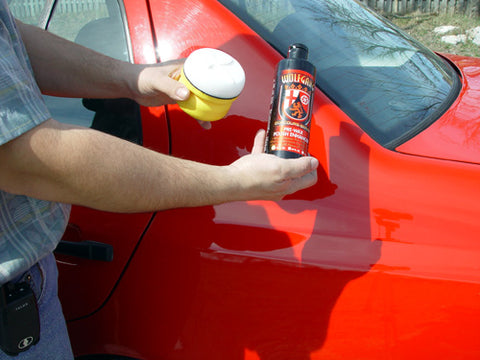
Apply the product to the applicator. Here we are using Wolfgang Paintwork Polish Enhancer. Wolfgang has great swirl hiding capabilities.
STEP 4
Using moderate pressure, work the product in back-forth motions. Switch directions every few strokes mimicking an X pattern.

STEP 5
Wipe off residue using a quality microfiber towel.(Tornado or Cookie Monster Towel)

Depending on what type of product you used, you will now be ready for either polish, or a wax/sealant. If the swirl remover you used was a dedicated swirl remover which only removes swirls, you will want to continue to the polishing product. Polishing products have the gloss enhancers necessary for that show car shine. If you used an-all-in-one polish with swirl hiding capabilities then you can go right to the wax/sealant stage!
Removing Swirls with Machine Polisher

- It’s best to work in a cool shaded area; this allows the product more time to work in before drying up. When working in direct sun, or on a hot surface the product will harden and make it hard, or impossible to work with.
- Work with one area at a time. A 24”x 24” (Half a door) is a good size .
STEP 2
Here I am using a Lake Country 6.5" Orange Foam Cutting Pad; I will mist the pad with water to prime the pad. Always prep your pads.(See Pad Prep Article) Proper pad preparation is often over looked. Using the correct methods will lengthen the life of your pad, as well as give you better results. Never start with a bone dry pad.
STEP 3
Apply a bead in an X pattern across the pad. I will start with Poorboy’s SSR 2.5

STEP 4
Dab the pad in several locations on your surface to distribute the product evenly.

STEP 5
Start by setting the dial on a low speed at first and work the product in all areas for 10-15 seconds. This will eliminate sling and prime the surface and pad of product. I usually do this at setting 3. You can use figure 8 patterns, S Patterns or any other consistent overlapping pattern.

Be sure to consistently cover the entire working area evenly. DO NOT apply excessive pressure! Doing so will not benefit you at all and will only cause premature wear on your pads. Press down slightly and make sure you are not deforming the pad.
STEP 6
After 10-15 seconds, kick up the speed to 5 or 5.5 using the same patterns as above. Work the product in until it becomes nearly transparent and just starts to dry. Buffing too long will often cause gumming up on the pad and likely scuff the surface. This scuffed surface will have to be worked again using the same procedure.
STEP 7
Use a microfiber buffing towel (The Cookie Monster) to wipe away any residue. Inspect the area, are the swirls gone? If not, repeat the process until they are. Remember, it’s not a race, this process can take time. An average sized vehicle can take 2-4 hours for the swirl removal process.

STEP 8
After the area is free of swirls you may notice a slight hazing or fog like finish (More noticeable on dark colors). This is completely normal. This is caused by the abrasives and cutting pad in the previous step. To eliminate this we will step down on the pad and/or the product. How much you step down depends on the combination that you are using. Here I use a 6.5" White Polishing Pad. with a milder product: Poorboy’s SSR2 . Repeat the same procedure as previous steps. The surface will now be crystal clear begging for some protection.
You are now ready for Sealant and Wax! Your swirl free surface will expose the full potential of your polish and wax producing a show car finish that will leave people breathless.
